Every healthcare specialty and navigation company says it saves money. Benefits leaders and CFOs have heard plenty of those numbers, and they have learned to ask the obvious follow-up: According to whom?
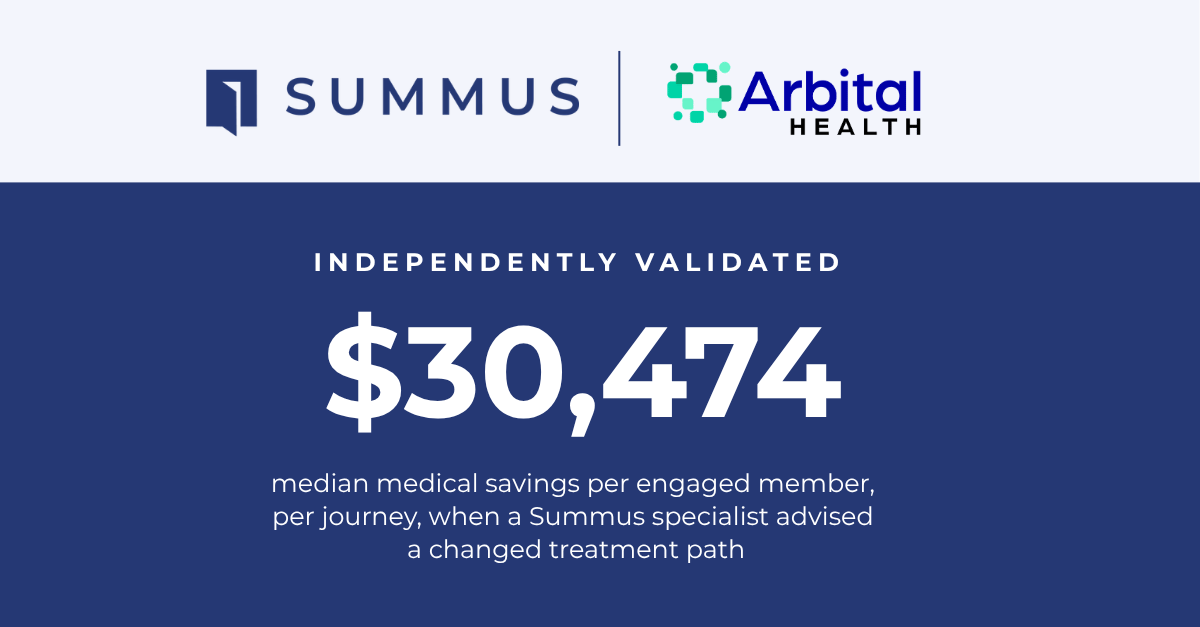
When a Summus physician guides a member toward the best-fit treatment path, it’s tied to real savings — $30,474 per case, according to a new independent report from Arbital Health, an outside actuarial firm that provided calculations using real medical claims data.
We wanted a better answer than “according to us.” So we asked Arbital to remodel our savings methodology from scratch and test it against industry-standard claims data. Today we’re publishing what they found.
The headline: $30,474 in median modeled medical savings per engaged member, per journey, when Summus changed a member’s treatment path.
This is the second independent look at our approach. In 2022, Milliman reviewed our broader savings methodology and found it actuarially reasonable and consistent with typical actuarial practice. Arbital went a step further by running the numbers themselves.
“Employers and health plans are under increasing pressure to manage the rising cost of specialty care while continuing to support members through the most complex journeys in healthcare,” said Julian Flannery, Founder and CEO of Summus. “This independent analysis adds important evidence to the economic value of our model and demonstrates the potential impact of giving members timely access to trusted physicians who support and orchestrate members through their care journey.”
The study measures one outcome of physician-led orchestration: A changed treatment path
Summus is a physician-led, multi-specialty platform that helps members navigate complex, high-cost health journeys — from a new diagnosis to a surgery decision. When guidance from a Summus physician leads a member to a different care plan — often less invasive, sometimes eliminating the need for a procedure altogether — we call that a changed treatment path.
“For members navigating complex care, the challenge is often not a lack of information, but making sense of multiple options, sequencing treatment choices, and focusing on the right specialties involved at the moments when decisions matter most,” said Mary Mulcare, M.D., Chief Medical Officer of Summus. “Our physician-led model is designed to provide continuity and clinical guidance across those transitions, helping members better understand their options, connect with the right expertise, and move through their care journey with greater clarity.”
We asked Arbital to focus specifically on this outcome because it’s the one that can be checked directly against real claims data. In 109 cases, Arbital measured whether the new plan of care cost less than the one the member was originally headed toward.
Real cases, real claims data, checked by outside actuaries
- Remodeled the engine. Arbital remodeled the Summus medical cost impact calculation using the published methodology.
- Analyzed 109 real Summus cases. For each case, Arbital analyzed billing codes (or CPT codes) involved with changed treatment paths while using MarketScan for real claims dollar values.
- Compared the two paths. They found groups of similar patients in the database who had each treatment, then compared what the two paths typically cost.
Because the comparison uses benchmark groups rather than our members’ own claims, these are modeled savings. They’re also gross savings, shown before Summus program fees.
The savings hold steady no matter how long you measure
A fair question about any savings figure is whether the time frame was handpicked. So Arbital measured costs at four different windows. Each window also counts the 15 days before the planned procedure.
| Costs counted through | Savings per member | Total across 109 members |
| 30 days after the procedure | $30,474 | $3.32M |
| 45 days after | $31,425 | $3.43M |
| 60 days after | $31,587 | $3.44M |
| 90 days after | $31,378 | $3.42M |
Savings are positive in every window and vary by only about 3%, so the result is not a reflection of one particular time frame. Savings were also positive across every condition category Arbital analyzed.
Employers keep nearly all of the savings, but members save, too
Arbital measured savings two ways: the total cost of care, and what the health plan actually paid after members’ copays and deductibles. Those two figures were quite close. On a plan-paid basis, savings came to $29,464 per engaged member, per journey.
97% of the savings show up in what the health plan pays. About $1,000 in lower out-of-pocket costs for each member. In other words, the savings aren’t coming from shifting costs from employers onto employees — members also ended up paying less.
What the study doesn’t claim
We asked for an independent review because we wanted numbers that hold up to scrutiny, so we also want to be transparent about the study’s limits.
This study compares the modeled costs of two treatment paths. It does not establish causality, and it is not a before-and-after study of individual members. It also doesn’t measure clinical outcomes or net ROI, since program fees were outside its scope.
Arbital also reviewed cases where Summus advised a changed diagnosis rather than a procedure, and while it showed savings as well, Arbital recommends treating those as an open area for further work rather than a validated result.
Read the full report
The complete report includes Arbital’s full methodology, how it handled incomplete or unusual case data, and detailed sensitivity results. Download the report.